
Catalogue
One agroforestry system, many yields.
A Wanakaset agroforest is not a rubber plantation — it is a fully integrated multistrata system. Alongside rubber, the network grows a huge diversity of fruits, nuts, vegetables, aromatics, stimulants, medicinal plants, fibre crops and timber. This is what's available to source from the network today, all outcome verified and part of the same rich story of place-sourced regeneration.
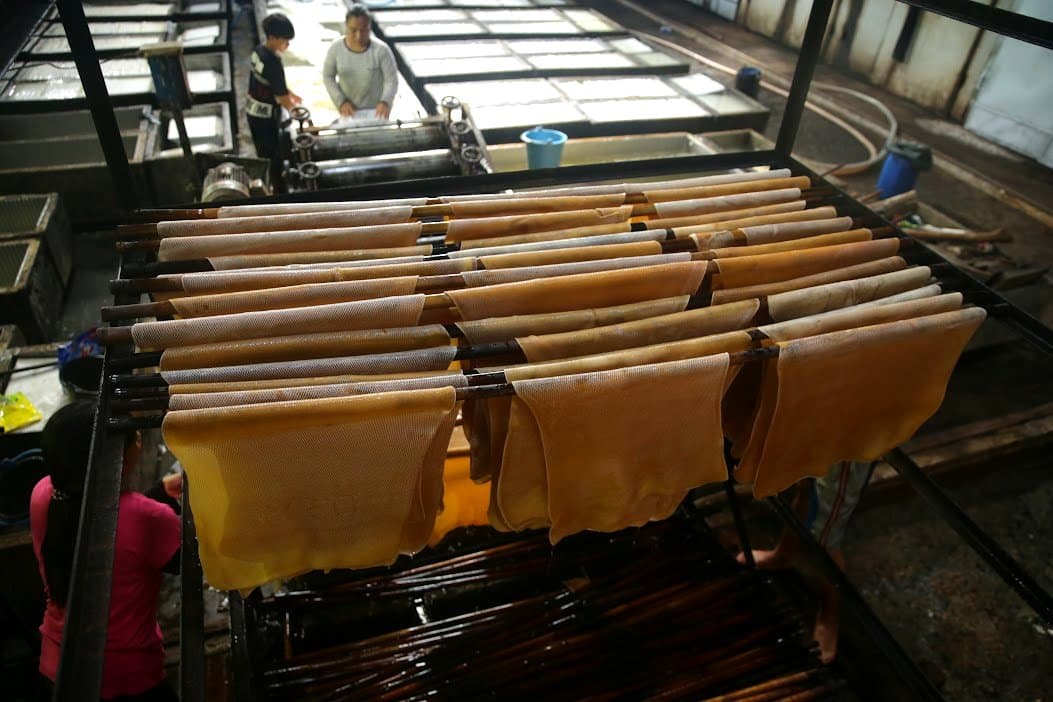
Keystone crop · Available now
Natural Rubber
Hevea brasiliensis
Regenerative ribbed smoked sheet and field latex, tapped from biodiverse Wanakaset agroforests — outcome-verified, fully traceable to the plot, and EUDR-ready. The network's keystone crop.
≈40–80 MT / month≈1,000 MT / year
Outcome-verified
Every lot carries plot-level evidence of its ecological and social outcomes — soil health, biodiversity, carbon, and farmer livelihoods — independently verified.
A streamlined transactional process
Rubber moves through a structured cycle — discovery, compliance and due-diligence review, verification, then transaction — with good prices and fair terms.
Regenerative Rubber Alliance supported
Supported by the RRA since 2022 — a multi-stakeholder initiative including farmer cooperatives, processors, universities, local government and brands — committed to transitioning all of the rubberlands of the Songkhla Lagoon Watershed (1% of global production) to regenerative agroforestry by 2030.
 Fruit
FruitLangsat
Lansium parasiticum
Translucent, grape-sweet fruits borne in heavy clusters — the network's single largest fruit crop by projected volume.
Volume
≈39 MT / yr
 Nut & Bean© Nafisathallah · CC BY-SA 4.0
Niang Bean
Archidendron jiringa
Earthy, protein-rich seeds eaten across the South — one of the network's highest-volume specialty crops.
Volume
≈15 MT / yr
 Nut & Bean
Bitter Bean (Sator)
Parkia speciosa
Pungent, nutritious beans in long twisted pods — a beloved Southern Thai ingredient and the most evenly distributed commercial crop in the network.
Volume
≈13 MT / yr
 Fruit© Shagil Muzhappilangad · CC BY-SA 4.0
Mangosteen
Garcinia mangostana
The 'queen of fruits' — a thick purple rind around fragrant, segmented white flesh, prized across Asia.
Volume
≈10 MT / yr
 Fruit© PattayaPatrol · CC BY-SA 4.0
Thai Banana
Musa (Pisang Awak / Kluai Namwa)
A sweet, hardy cooking-and-eating banana — a staple layer of nearly every agroforest in the network.
Volume
≈9 MT / yr
 Fruit
FruitDurian
Durio zibethinus
The 'king of fruits' — custard-rich and intensely aromatic; a premium crop grown by the network's specialist orchardists.
Volume
≈6 MT / yr
 Stimulant
Betel Nut (Areca)
Areca catechu
The seed of the slender areca palm — a long-traded regional masticatory and one of the network's higher-volume specialty crops.
Volume
≈6 MT / yr
 Medicinal
Siamese Neem
Azadirachta indica
The bitter young shoots and flowers are a seasonal Thai delicacy, and neem extracts serve as a natural biopesticide. The most widely grown species in the network.
Volume
≈5.6 MT / yr
 Vegetable© Forest & Kim Starr · CC BY 3.0
Pak Liang
Gnetum gnemon
The glossy young leaves of Gnetum gnemon — a mild, much-loved Southern Thai green, eaten stir-fried with egg or in soups and curries.
Volume
≈5 MT / yr
 Fruit
FruitCoconut
Cocos nucifera
Water, flesh, and oil from the canopy palm — a multi-use staple across the network.
Volume
≈4.8 MT / yr
 Stimulant
Robusta Coffee
Coffea canephora
Shade-grown Robusta nurtured beneath the rubber canopy — a high-value crop on the rise in the network.
Volume
≈4 MT / yr
 Fruit
FruitPineapple
Ananas comosus
Sun-ripened pineapple grown in the open layers of the agroforest.
Volume
≈3 MT / yr
 Fruit
FruitSnake Fruit (Salak)
Salacca zalacca
Crisp, sweet-tart segments beneath a distinctive scaly skin, from a clumping understory palm.
Volume
≈2.5 MT / yr
 Fruit© ArionStar · CC0
Rambutan
Nephelium lappaceum
Sweet, translucent flesh inside a soft, hairy red rind — a lychee relative ripening in the agroforest canopy.
Volume
≈2 MT / yr
 Fruit
FruitJackfruit
Artocarpus heterophyllus
Enormous spiny fruits packed with fragrant golden pods — eaten ripe or cooked green, from a hardy multi-use canopy tree.
Volume
≈1.9 MT / yr
 Fruit
FruitCempedak
Artocarpus integer
A smaller, more intensely fragrant cousin of jackfruit — custard-soft golden flesh prized across the South.
Volume
≈1 MT / yr
 Fruit
FruitMango
Mangifera indica
Grown in scattered plantings across the network — eaten green and tart in Southern Thai salads, or sweet and ripe.
Volume
≈0.2 MT / yr
 Fruit
FruitAvocado
Persea americana
Buttery, nutrient-dense fruit from the agroforest canopy — an emerging high-value crop, grown in small but rising volumes.
Volume
≈0.15 MT / yr
 Nut & Bean© Wilfredor · CC0
Cashew
Anacardium occidentale
Cashew apples and nuts from scattered plantings across the network.
Volume
By arrangement
 Stimulant
Kratom
Mitragyna speciosa
A native coffee-family tree of long traditional use in Southern Thailand.
Regulated crop — sourcing subject to legal compliance.
Volume
By arrangement
 Stimulant© Luisovalles · CC BY 3.0
Cacao
Theobroma cacao
Cacao pods ripening in the shade of the agroforest — the raw material of chocolate, and an emerging high-value crop in the network.
Volume
By arrangement
 Honey© Queenzlander · CC BY-SA 4.0
Stingless Bee Honey
Meliponini spp. (Tetragonula laeviceps, Heterotrigona itama & Geniotrigona thoracica)
Tangy, floral honey from native stingless bees kept within the agroforest. These tiny pollinators yield honey in small quantities — thinner and more citrus-sharp than honeybee honey, and long prized across Southern Thailand. A hive product of the same biodiverse system that grows the network's crops.
Volume
By arrangement
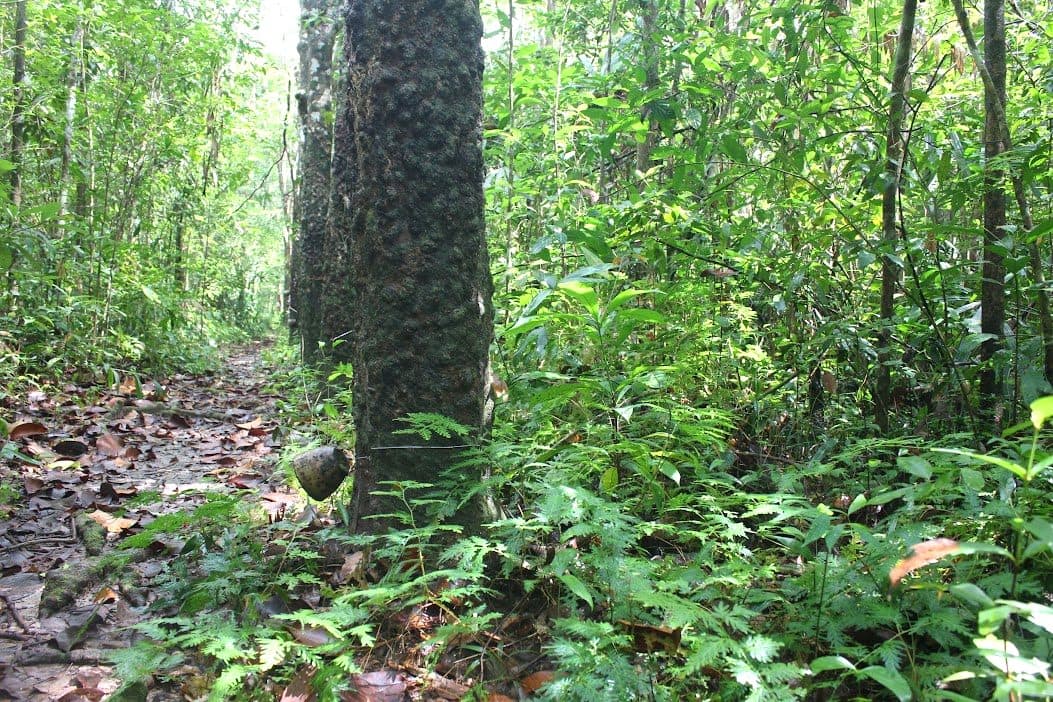
More than the list
A whole forest of possibility.
Wanakaset agroforests are extraordinarily diverse — the richest farm we've surveyed grows over 100 named crop varieties on under two hectares. If you're looking for something not shown here, it may well be available.
Ask about other cropsSourcing note. Regenerative Rubber smoked rubber sheets are available to purchase today.
For all ancillary crops please contact us to confirm seasonal availability, processing, grades, and lead times.
A full ordering and compliance flow is coming as the marketplace launches — talk to us in the meantime.
Where it grows
Every yield traces back to a community.
The crops in this catalogue are grown across the community enterprises of the Wanakaset Symbiosis Network — each with its own land, history, and signature crops. Explore who grows what.
Explore the network →